- Products / Technology
- Vehicle
- NEWFeb. 02, 2026
Daihatsu Launches First Mass-Produced BEVs e-Hijet Cargo and e-Atrai
Feb. 02, 2026
DAIHATSU MOTOR CO., LTD.
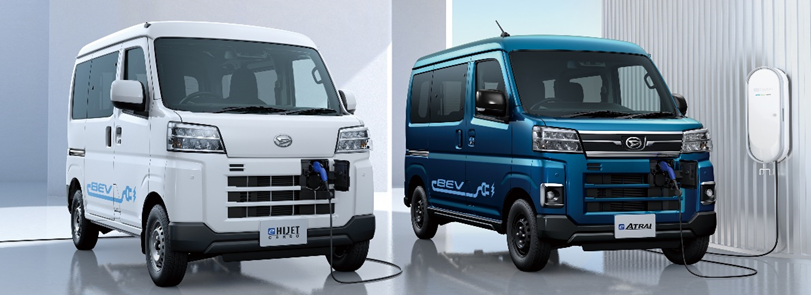 e-Hijet Cargo Four-Seater <Manufacturer’s Option>(Left)、e-Atrai RS <Manufacturer’s Option>(Right)
Daihatsu Motor Co., Ltd. (hereinafter “Daihatsu”) will launch its first mass-produced*1 battery electric vehicles (BEVs), the e-Hijet Cargo and e-Atrai, based on the mini commercial vehicles Hijet Cargo and Atrai models, nationwide starting February 2.
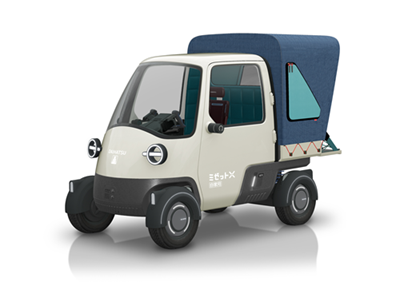
Since the launch of the mini three-wheeled vehicle, Midget, in 1957, Daihatsu has continued to manufacture mini commercial vehicles across Japan, serving as the “working partner” for people in diverse industries including agriculture, forestry, fisheries, construction, and delivery services. Daihatsu has provided vehicles that meet customer needs, ranging not only from trucks to vans, but also including special-purpose vehicles like dump trucks and panel vans. Additionally, in the 1960s, Daihatsu pioneered the development of electric vehicles ahead of its competitors and has actively pursued the electrification of commercial vehicles ever since.
In recent years, as efforts toward achieving a carbon-neutral society have advanced, expectations have been rising for the electrification of mini commercial vehicles that support last-mile logistics and various industries. The e-Hijet Cargo and e-Atrai feature the newly developed e-SMART ELECTRIC BEV system optimized for mini vehicles. Part placement has been revised, and the body and suspension newly designed, to accommodate a large-capacity battery without compromising interior space. With No.1*2 loading space among mini cab-over vans (e-Hijet Cargo Four-Seater) and excellent usability, they retain the appeal of mini commercial vans, while achieving the No.1*3 cruising range per charge for mini commercial BEV vans in WLTC mode (Ministry of Land, Infrastructure, Transport and Tourism test value) of 257 km*4. They also deliver the high fundamental performance unique to BEVs (driving performance, ride comfort, quietness), contributing to reduced driver fatigue.
Production will take place at Daihatsu Motor Kyushu Co., Ltd.’s Oita (Nakatsu) Plant No.1. Leveraging the technology and expertise developed over many years at this plant in producing mini passenger vehicles and mini commercial vehicles, as well as small-volume, high-mix special-purpose vehicles, Daihatsu has achieved mixed-model production with gasoline-powered vehicles on existing production lines without introducing dedicated BEV equipment.
Daihatsu will continue to provide high-quality and affordable mini commercial vehicles that support the daily lives of customers. By contributing to reducing CO2 emissions in the logistics industry, Daihatsu aims to realize carbon neutrality based on the multi-pathway approach.
*1: As of February 2026, according to research conducted by Daihatsu.
*2: As a light-duty vehicle with a body structure lacking an engine (motor) room in front of the driver seat, it ranks No.1 in luggage space length, width (when seating four passengers), and height. As of February 2026, according to research conducted by Daihatsu. Vehicles with the same values exist within the company and among competitors.
*3: No.1 light-duty vehicle among electric vehicles (BEVs). As of February 2026, according to research conducted by Daihatsu. Vehicles with the same values exist within the company and among competitors.
*4: The cruising range per charge is a value measured under specified test conditions. The actual cruising range per charge may vary significantly depending on the customer’s usage environment (weather, traffic congestion, etc.) and driving habits (sudden acceleration, air conditioner use, etc.). WLTC mode is an international driving mode comprising an allocation of average use times in urban, suburban, and highway driving modes.
Concept

Main Features
Ⅰ. It remains the No.1 mini cab-over van*5 in loading space (e-Hijet Cargo Four-Seater) and convenience. Equipped with the e-SMART ELECTRIC system, it delivers high fundamental performance that reduces driver fatigue, while achieving the No.1*6 cruising range per charge for mini commercial BEV vans in WLTC mode (Ministry of Land, Infrastructure, Transport and Tourism test value) of 257 km*7.
Ⅱ. Standard equipment on all models includes an external power supply function for charging works tools and providing peace of mind during disasters (AC 100V), plus a fast-charging inlet that can also be utilized for V2H (Vehicle to Home) *8.
Ⅲ. e-Atrai setting: a premium-feel passenger/commercial vehicle hybrid
*5: As a light-duty vehicle with a body structure lacking an engine (motor) room in front of the driver seat, it ranks No.1 in luggage space length, width (when seating four passengers), and height. As of February 2026, according to research conducted by Daihatsu. Vehicles with the same values exist within the company and among competitors.
*6: No.1 light-duty vehicle among electric vehicles (BEVs). As of February 2026, according to research conducted by Daihatsu. Vehicles with the same values exist within the company and among competitors.
*7: The cruising range per charge is a value measured under specified test conditions. The actual cruising range per charge may vary significantly depending on the customer’s usage environment (weather, traffic congestion, etc.) and driving habits (sudden acceleration, air conditioner use, etc.). WLTC mode is an international driving mode comprising an allocation of average use times in urban, suburban, and highway driving modes.
*8: Electricity stored in the vehicle’s battery can be supplied to the home by using V2H equipment. V2H equipment must be purchased separately.
*Manufacturer’s recommended retail price (including consumption tax)*
Prices are recommended retail prices and are intended for reference purposes only. Prices are independently set by sales companies; for further details, please visit your nearest sales company. Insurance, taxes (excluding consumption tax), automobile recycling fees and fees associated with registration, etc. are charged separately.
<e-Hijet Cargo>
| Grade | Drive System | Price (yen) |
|---|---|---|
| Two-seater | 2WD | 3,146,000 |
| Four-seater☆ | 2WD | 3,146,000 |
<e-Atrai>
| Grade | Drive System | Price (yen) |
|---|---|---|
| RS☆ | 2WD | 3,465,000 |
☆Photo included
*Sales Target*
Monthly production of 300 units (combined total for two models)
*Production Plant*
Daihatsu Motor Kyushu Co., Ltd. Oita (Nakatsu) Plant No. 1
*Vehicle Overview*
Ⅰ. Newly Developed BEV System e-SMART ELECTRIC
- A BEV system jointly developed by Suzuki Motor Corporation, Daihatsu Motor Co., Ltd., and Toyota Motor Corporation, combining the expertise in small vehicle manufacturing cultivated by Daihatsu and Suzuki with Toyota’s electrification technology
- The e-Axle, which integrates the motor, inverter, and reduction gear, is mounted on the rear drive axle, while a high-capacity 36.6 kWh thin lithium-ion battery is positioned under the floor
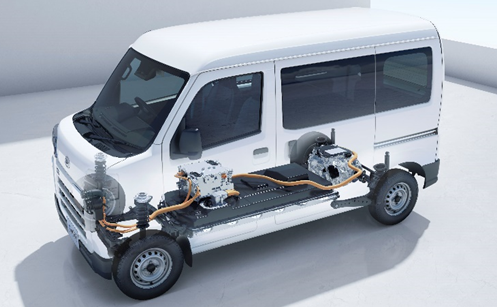 e-SMART ELECTRIC (concept image)
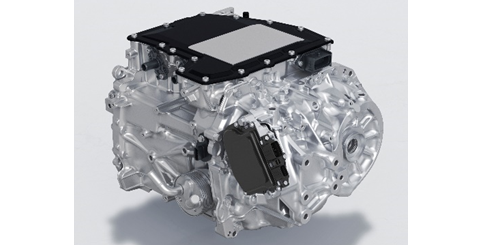 e-Axle
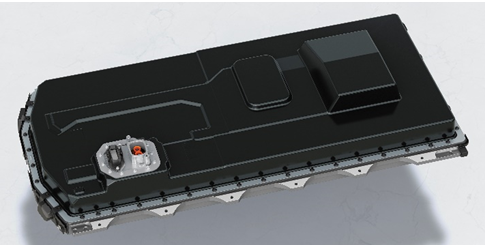 High-capacity lithium-ion battery
1. High fundamental performance (driving performance, ride comfort, quietness) unique to BEVs
(1) Responsive acceleration performance and smooth driving performance
- Generates ample torque from the start of driving, while appropriate regenerative braking improves electric efficiency and driving ease
- e-Axle mounted on the rear drive axle enables powerful starts and smooth acceleration with high rear-wheel grip, even under heavy loads or when climbing hills
(2) Stable handling and ride comfort achieved through a low center of gravity
- A slim, high-capacity battery is placed under the floor, lowering the center of gravity compared to conventional gasoline vehicles, improving handling stability, and preventing cargo shifting
- Vehicle rigidity is enhanced through BEV-specific structural reinforcements, while ride comfort is improved by adopting newly designed trailing link axle coil springs (rear) and other features
(3) Enhanced quietness
- 100% motor operation achieves quietness that ensures peace of mind not only indoors, but also during early morning or late-night drives and frequent stops in residential areas, contributing to reduced driver stress
2. No.1*9 cruising range per charge for mini commercial BEV vans
- Adopts highly safe lithium iron phosphate (LFP) batteries
- Large capacity battery with 36.6 kWh*10, achieving cruising range per charge in WLTC mode (Ministry of Land, Infrastructure, Transport and Tourism test value) of 257 km*11
- Ensures sufficient range for most mini commercial van users even during summer and winter when power consumption increases due to air conditioning and other factors
- Running costs are lower compared to gasoline, making it economical for daily commutes of similar distances. With fewer consumables such as oil and reduced maintenance needs, the vehicle offers low running costs, providing peace of mind even during long-term ownership.
* 9 : No.1 light-duty vehicle among electric vehicles (BEVs). As of February 2026, according to research conducted by Daihatsu. Vehicles with the same values exist within the company and among competitors.
*10: Calculated based on definitions in the United Nations Recommendations on the Transport of Dangerous Goods
*11: The cruising range per charge is a value measured under specified test conditions. The actual cruising range per charge may vary significantly depending on the customer’s usage environment (weather, traffic congestion, etc.) and driving habits (sudden acceleration, air conditioner use, etc.). WLTC mode is an international driving mode comprising an allocation of average use times in urban, suburban, and highway driving modes.
3. Standard features across all vehicles to spread the joy of BEVs
(1) Standard external power supply function across all vehicles, useful in all situations from daily life to emergencies
- Equipped with an AC 100V accessory outlet that can be used even while driving and allows the use of electric products with a maximum combined power consumption of 1500 W or less
- For disasters or other situations requiring power, it is also equipped with an emergency power supply system that supplies electricity while the vehicle’s driving functions are stopped
- Using the included external power supply attachment, the power cord can be routed outside the vehicle to provide electricity even with the front door and door glass closed
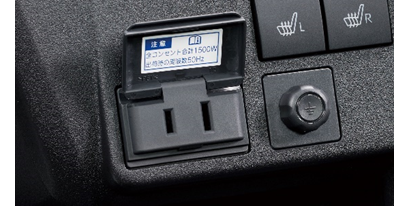 Accessory outlet
(AC 100V・1500W/1 unit/with emergency power supply system)
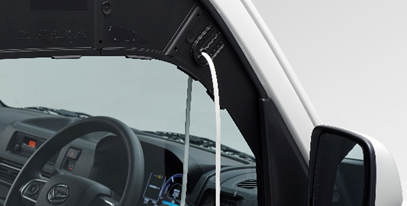 External power supply attachment
(2) Standard CHAdeMO-compatible fast-charging inlet across all models, enabling fast charging and V2H (Vehicle to Home)
- Standard fast-charging inlet across all vehicles, compatible with fast chargers when away from home
- With fast charging, it reaches 80%*12 in about 50 minutes from the when the low battery warning light comes on, enabling quick charging during shopping trips or service area breaks
- The fast-charging inlet enables both “vehicle charging” and “powering buildings from the vehicle,” making V2H usage possible
*12: For a fast charger with 50 kW output at a battery temperature of 25℃
 V2H concept image
Ⅱ. High Loading Capacity and Excellent Usability Equivalent to the Base Model, Along With Advanced Safety Features
(1) No.1*13 loading space among mini cab-over vans, achieved through meticulous packaging of the BEV system (e-Hijet Cargo Four-Seater)
- The e-Hijet Cargo achieves the No.1*13 loading space among mini cab-over vans equivalent to the base model (e-Hijet Cargo Four-Seater) and a maximum loading capacity of 350 kg by optimally positioning a high-capacity battery and the e-Axle under the floor. It retains the mini commercial van’s loading capacity and excellent usability
- 30 interior nuts with excellent usability, plus a flat luggage space floor that eliminates bumps and grooves to prevent damage to belongings and make loading and unloading easier
- The upper tray and overhead shelves that utilize headroom space inside the cabin provide ample storage space, primarily within easy reach from the driver seat, ensuring easy loading and unloading of cargo and a comfortable working environment
*13: As a light-duty vehicle with a body structure lacking an engine (motor) room in front of the driver seat, it ranks No.1 in luggage space length, width (when seating four passengers), and height. As of February 2026, according to research conducted by Daihatsu. Vehicles with the same values exist within the company and among competitors.
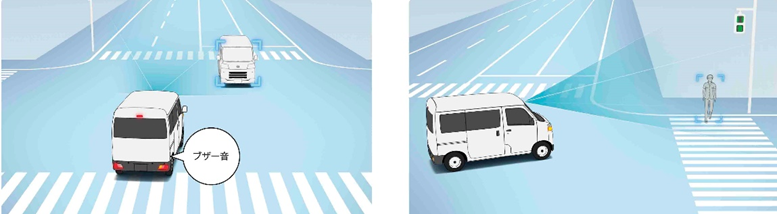
(2) Equipped with the latest preventive safety system Smart Assist*14
- The enhanced performance of the stereo camera enables broader detection and recognition, leading to the evolution of collision warning functions (for vehicles/pedestrians [day/night]) and collision-avoidance support braking (for vehicles/pedestrians [day/night])
- Specifically, bicycles crossing the road, vehicles traveling straight from the opposite direction at intersections when turning right, and pedestrians crossing from the opposite direction when turning right or left, are also detectable
*14: Smart Assist is designed to assist the driver, but its functions are limited. Depending on road conditions, weather, and other factors, the system may not activate. Do not rely solely on the system; always drive safely. For details, please consult your sales company or the official website.
<Can detect bicycles crossing>

<Can detect oncoming vehicles when turning right and pedestrians crossing the road when turning left or right>
(3) Additional enhanced features
- It also adopts LED headlights and energy-efficient seat heaters (driver/passenger seats), implementing measures to enhance convenience while reducing power consumption
Ⅲ. e-Atrai: Meticulously Crafted Interior and Exterior Finishes, Designed for Both Passenger and Commercial Use
- The e-Atrai maximizes luggage space equivalent to the base model while serving as a versatile model for both work and personal use
- Enhanced quality with an exterior featuring black accents and chrome trim, and a black-based interior
- Equipped with convenient features like the power sliding doors on both sides
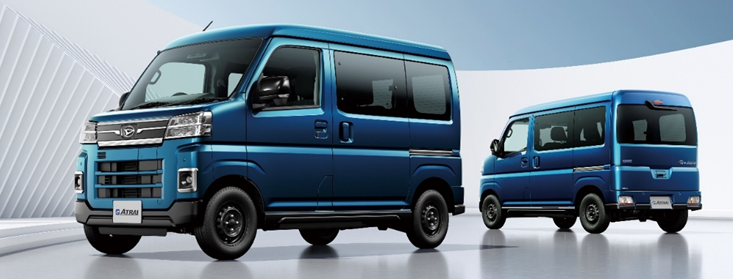 e-Atrai RS Exterior *15
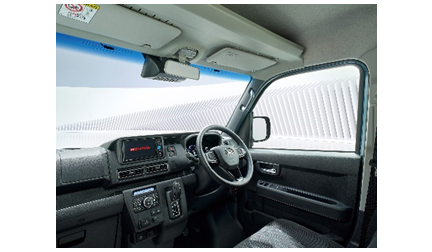 e-Atrai RS Interior *15
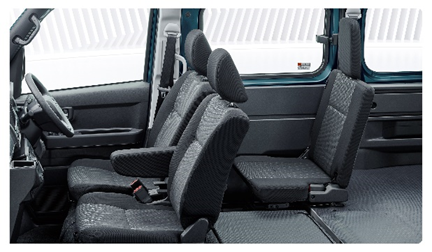 e-Atrai RS Seats *15
*15: Vehicle equipped with optional features